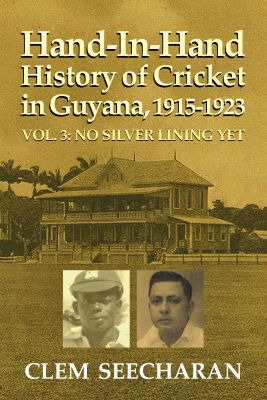
Despite the suspension of intercolonial and international cricket during the Great War, the passion for the game in British Guiana (Guyana since 1966) was undiminished - a vibrant and resilient club cricket culture crystallised. In Georgetown, the capital (in the county of Demerara), competitive cricket was enhanced by a three-tier organisational structure. Furthermore, the game, administered primarily by the all-white Georgetown Cricket Club (GCC), was undergoing a quiet revolution. The dominance of the GCC in the first division Parker Cup was being effectively challenged by clubs comprising proficient non-white players, including those of various shades of lightness, the 'Coloureds' (mixed ancestry) and Madeiran Portuguese. The British Guiana Cricket Club (BGCC) won the Parker Cup three years running (1917-1919), and the Demerara Cricket Club (DCC) did so in 1920. This period also saw the founding of the East Indian Cricket Club (EICC) by the visionary J.A. Veerasawmy. This third volume of Hand-in-Hand History of Cricket in Guyana examines club cricket within the wider social and ethnic complexities of colonial society, highlighting two remarkable pioneers: C.R. 'Snuffy' Browne (1890-1964) and J.A. Veerasawmy (1889-1947). Snuffy represented British Guiana between 1921 and 1938, was the first Black captain in the Intercolonial Cricket Tournament (in 1921). He was the finest Guyanese cricketer between the Wars, yet he is still virtually unknown there. This book gives belated recognition to Snuffy and Veerasawmy. It concludes with the West Indies tour of England in 1923 - arguably pivotal to their acquisition of Test status from 1928. Although Guyanese endured health afflictions, particularly malaria, and a stubborn racial hierarchy, a profound hunger in their soul for cricket was inviolable.