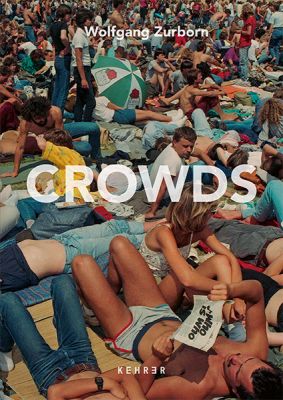
For more than four decades, Wolfgang Zurborn has observed people in public spaces, turning his camera towards encounters, gestures and coincidences that reveal the dynamics of social life. In Crowds, he brings together photographs taken since the 1980s, creating a vivid and multi-layered portrait of an era shaped by mass culture, social conditioning and the pervasive influence of the media. Political, sporting, religious, tourist and entertainment events become stages on which collective behaviour unfolds. Among densely gathered bodies, Zurborn captures moments in which their choreography gives rise to complex narratives about people's desires and fears. His photographs neither dissolve people into the ornamentation of the crowd nor isolate them as individuals detached from context. Instead, they reveal the networks of relationships between people, groups and their surroundings. The work reflecting on the pervasive presence of mass media in contemporary life. Working in the tradition of colour street photography, Zurborn embraces the visual abundance of public life rather than attempting to impose a clear hierarchy upon it. His images are crowded with information, inviting the eye to move between foreground and background, between seemingly incidental details and larger patterns. What initially appears chaotic gradually reveals a subtle visual order-one that never fully resolves the unpredictability and vitality of the scene. The project took shape during the lockdowns of the coronavirus pandemic, when public gatherings had suddenly come to a standstill. Zurborn used this period to return to his archive, scanning hundreds of analogue colour negatives and discovering connections across decades of photographs. The enforced pause in an overstimulated mass culture prompted him to reflect anew on the ways people are shaped by their social environment and the media that surround them, and on the possibility of living a self-determined life. Crowds does not impose a singular interpretation. Rather, Zurborn's photographs convey an expressive sense of the present moment, inviting us to look closely at the complex, contradictory and often chaotic structures of contemporary society.